Casting Tin Coins
This article is from a Forum magazine issue.
Casting Tin Coins
Have you ever tried making your own money? Not paper money, but real, hard coins. Impossible? With these instructions and a little craftsmanship, you should be able to make your own coins.
Casting is a manufacturing process primarily used in the metal and plastics industries. The material (e.g., steel) is heated until it melts and then poured into a mold. As it cools, the material solidifies back into a solid object.
Tin is suitable for casting coins. Tin has a relatively low melting point (approx. 250 °C), which is why it can be melted using just a candle.
Casting Tin Coins
Preparation
The most important thing when casting is the mold. Without a usable mold, nothing works. The best materials to use for the casting mold are plaster or sandstone slabs.
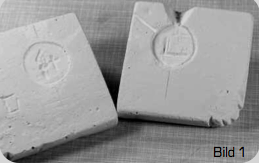
A casting mold always consists of at least two parts (see Figure 1). The shape of the coins is carved into one of the two slabs. For numbers and letters, make sure they are carved in mirror image! Engraving is best done with a scraper or chisel. A linoleum carving tool has proven effective. In a pinch, however, a screwdriver will also work. When carving out the design, make sure the edges have what is known as a “flash” (see Figure 2). The mold must not have any undercuts, otherwise the cast piece cannot be removed from the mold without damaging it. The second slab serves as a cover plate.
A sprue and, depending on the size of the coin, one or two vents complete the mold. Vents are air release holes. These prevent air bubbles from forming in the mold during casting and ensure that the mold is completely filled with tin.

The Casting Process
The two mold halves are now held together with a clamping device (e.g., a vise; see Figure 3). The tin is melted in a ladle using a Bunsen burner and then poured into the pouring spout. It is important to fill the mold without interruption. Once the tin has solidified, the coin can be removed from the mold. Now just quickly cut off the sprues (pouring spouts) from the cast coins, and your very first coins will be shining in the sun!
The Materials List
- Plaster or sandstone slab
- Scraper, graver, chisel
- Bunsen burner, fire, etc.
- Old trowel with spout
- Clamping devices (to hold the two mold halves together; e.g., vise, screw clamps, clamps)
- Side-cutting pliers for breaking up the tin rods
- Tin rods (raw material)
Hazards
Although tin casting isn’t difficult, there are a few precautions you should take.
Heat: Molten tin reaches a temperature of about 250 °C. Therefore, there is a risk of burns. The mold also heats up as the casting process continues. This causes the solidification process to take longer and longer. If you open the mold too early in this situation, molten tin will flow out of the mold and possibly onto your hands!
Fragile: Plaster is a very fragile material. Therefore, never drop the mold. Also, do not squeeze the mold too tightly.
Fumes: Toxic fumes are producedwhen tin is melted. Therefore, you should never cast tin in enclosed spaces for extended periods of time.
References

- Content and image: Forum Kind, Issue 2/05, page 14. Self-made millionaire, play money, camp supplies, casting coins. © Copyright www.forum-kind.ch
- Photo: UrsBänninger, Roman Camp 2003, Henggart Youth Group