
Recently modified articles
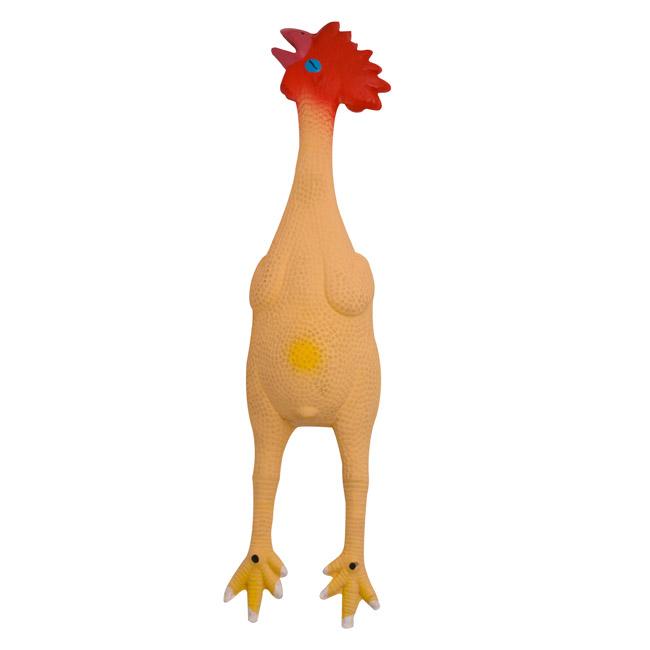
Materials needed: a rubber or plastic chicken or any other animal (preferably not made of plush, because it can get dirty)
Participants are divided into two teams; a playing field is marked off—divided into two halves—taking into account the number of participants, and free of obstacles.
The leader throws the chicken or other mascot onto the field after giving the signal to start the game. The players in the half where the chicken lands quickly form a line behind the mascot. Once everyone is in position, the person at the front passes the chicken between their legs to the person behind them. The mascot must move as quickly as possible through the space between the participants’ legs until it reaches the last person. Each person in the line, while helping the chicken move forward, also says their name. The last person in line runs with the chicken in front of the line, shouts “STOI,” and throws the chicken into the opposing team’s half of the field.
In this phase, the opposing team’s players form a line behind the chicken, while the player who threw the chicken must run around his own team, which forms a tight circle (similar to American football), until he hears the command “STOI” from the other team. The laps run around their own team count as points.
The game continues until a predetermined score is reached.
The game is extremely dynamic and fun; it’s best played outdoors.
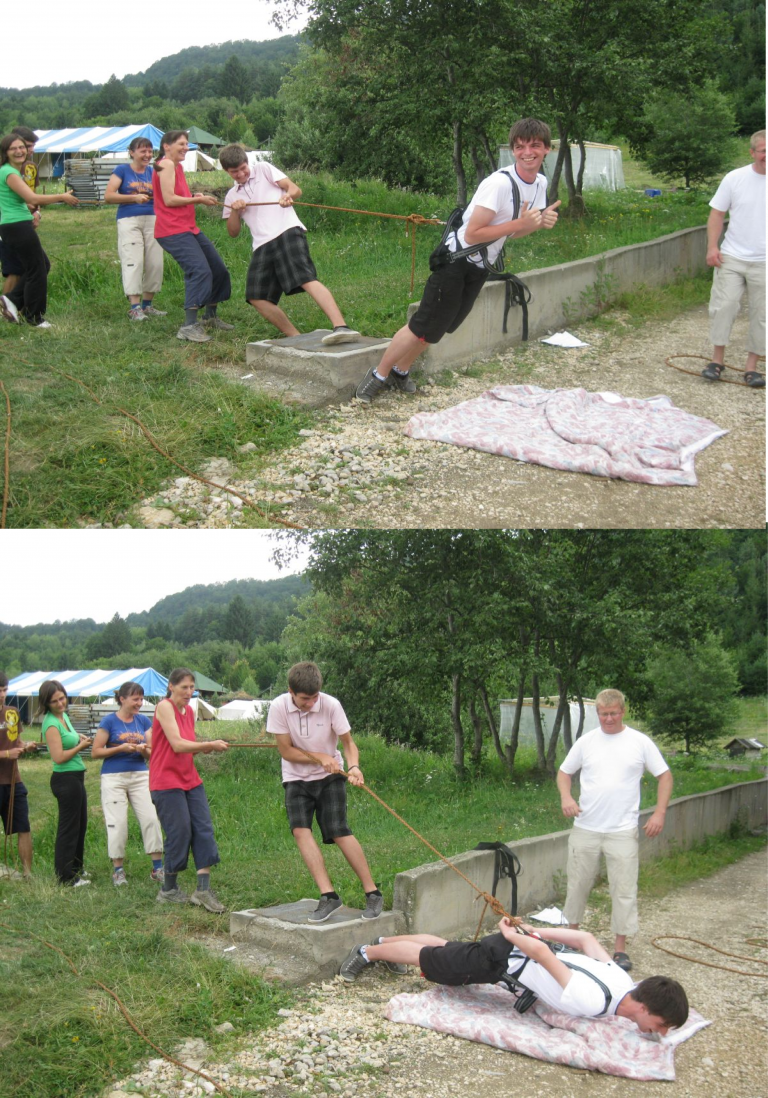
Materials needed: 1 harness, carabiner, rope, tarp/blanket—if there are many participants, you can double the materials to save time
Depending on the number of participants, two teams are formed.
One at a time, each participant will be fitted with the harness; the team’s task is to use physical strength to support the volunteer, lowering him gradually—without jerking him—until his nose touches the blanket, after which they lift him back up.
The volunteer is allowed to give commands such as “stop,” “slower,” “faster,” etc. Team members line up behind the volunteer and work together as a team.
For more information, see the accompanying images.
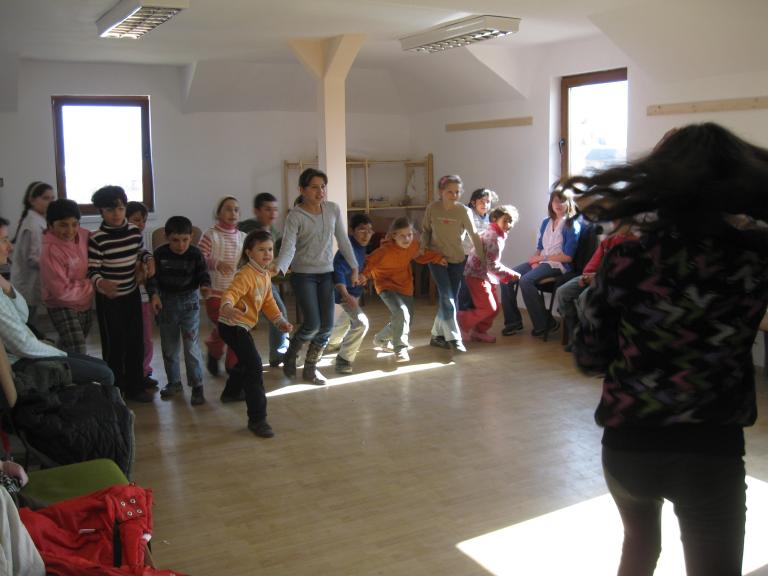
Participants line up at a distance of approximately 3–6 meters from the leader.
The leader will stand with their back to the participants.
At the start, participants try to move as quietly and smoothly as possible so that the leader cannot hear them. The goal is to reach the leader and take their place. From time to time, unexpectedly, the leader will give the command “freeze” and turn around. This is the moment when the participants must freeze. If the leader spots someone who has moved, that person will be asked to return to where they started.
The person who reaches the front first will take the leader’s place, and the game will resume.
No materials are needed.
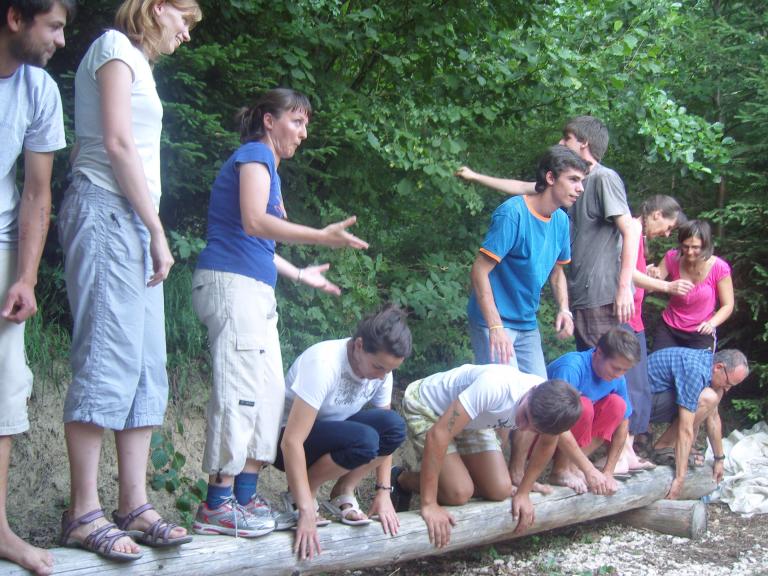
Materials needed: a log long enough for all of us to fit on it
Participants are invited to climb onto the log in random order.
They must complete the following tasks:
- Within a time limit (3 minutes), arrange themselves in alphabetical order by first name, from left to right, without touching the ground more than 5 times.
- Time trial: Arrange themselves in ascending order by age, without touching the ground more than 3 times
- Time trial: without speaking, line up in descending order by shoe size, without touching the ground at all.
Other fun challenges can be added. The time limit can be adjusted depending on how well they do.
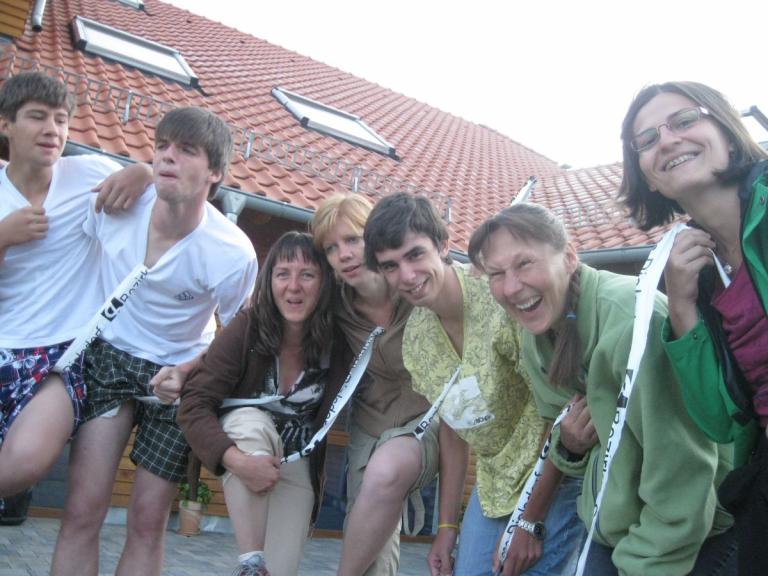
Materials needed: [one frozen spoon (placed in the freezer the night before), tied to a long piece of string or twine, depending on the number of participants (allow 1 m per person)] x number of teams
Participants are divided into 2 teams (between 4 and 12 members). Team members line up shoulder to shoulder in 2 parallel lines. The spoons with the ribbon or string wrapped around them are handed out to the teams. At the start, the task is to pass the “frozen” spoon under the clothes (shirt and pants) of all participants and back, then hand off the spoon with the ribbon or string wrapped around it exactly as they received it. All in record time. The team that finishes first wins.
An excellent icebreaker game.
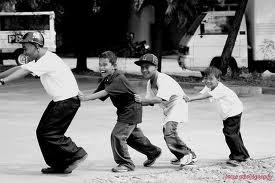
Materials needed: balloons, depending on the number of teams
Participants are divided into two teams (5–12 people). The teams form a line (with hands on shoulders or hips); the last person in each line receives a balloon attached to their pant leg. Within a marked-off area, the task for both teams is to pop the other team’s balloon while protecting their own.
TIP: Make sure the leaders of the two lines are of the same gender.
Image source: http://www.flickr.com/photos/jomsphotography/4084620391/

Sweet chocolate milk—perfect for making, for example, after an exciting night spent camping outdoors.
A spiritual program for a semester featuring 8 devotionals on the life and ministry of Jesus.

Several semester-long programs on the topic of Moses.

God created a beautiful world. The first man’s task was to care for the plants and animals that God had placed in the Garden of Eden. It is the duty of all people—and even more so of Christians—to show respect for God’s creation. Instead of destroying, cutting down, and wasting, let us appreciate, protect, and promote an attitude of gratitude for God’s magnificent creation.
Active involvement in caring for the environment can also create many opportunities for evangelism.

A great game for hot days.

The song "The Bible Has 66 Books" is a fun and accessible way to memorize the books of the Bible while maintaining the correct chronological order.
This game can wear out even the most energetic kids.
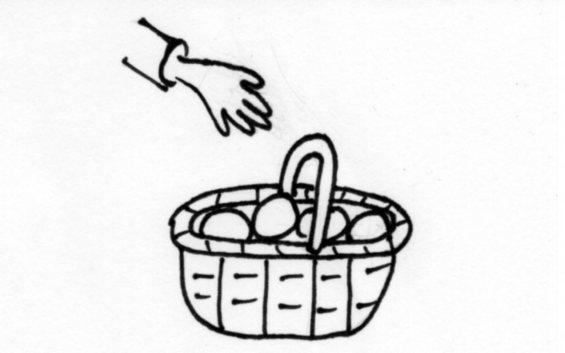
A very easy but fun game to warm up with.

Quiz on the Christmas story

Bolognese sauce is tasty, nutritious, and easy to make—even in the middle of the forest.
This recipe serves 6 people.
By replacing canned tomatoes with tomato paste and water, you can make a larger batch of sauce.

Muffins are an easy-to-make and attractive snack that you can bake with a group of friends to enjoy together or for a special occasion.
This recipe is for traditional English cupcakes.
This is how good newspaper articles are made:
A good public image builds trust and gives valuable relationships. Writing for newspapers can be done by those who have basic knowledge of spelling, grammar and sentence structure. This article will give you some valuable tips.