An action-packed trading game in which players try to earn as much money as possible. They can decide for themselves whether to do so honestly or to try to get away with smuggling. Features a progressive game system.
A Trappergame is an action-packed trading game that’s always a big hit with us. The children have to collect cards, each of which has a different value, and sell them at the market. The player or group with the most money at the end wins. The catch is that they’re only allowed to carry a certain number of certain cards. However, they can also buy better licences, which allow them to transport more and more valuable cards. They can also try to smuggle more, but all their money will be taken away if they’re stopped by the catchers along the way.
Playing area:
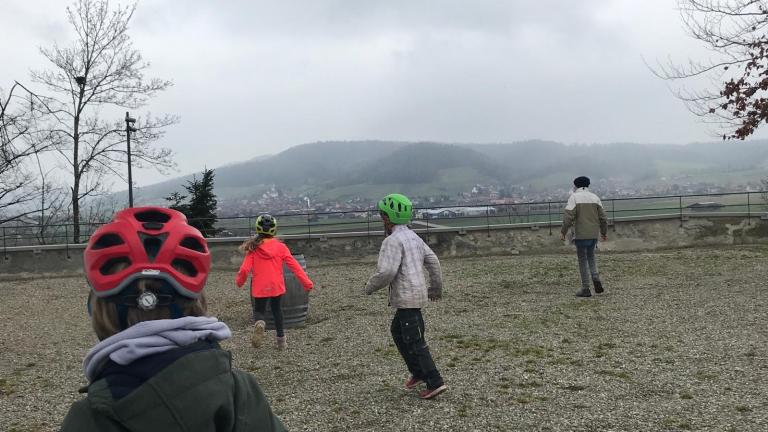
At one end of the playing field there is a collection zone, and at the other end there is a market. The controllers/catchers are positioned in between. Virtually any terrain is suitable, from a slope to a field or a wood; however, if a slope is involved, it is advisable to position the market higher up than the assembly area to minimise accidents during chases.
Next to the market, you can also set up a ‘prison’ where children caught smuggling must spend 2 minutes before they can continue playing.
Preparation:
Money:
To play the game, you’ll need a large amount of banknotes in various currencies, as the game quickly becomes capital-intensive. We used modified Monopoly money in denominations of 10,000, 50,000, 100,000 and 500,000. We have a large quantity of these, each printed on different coloured paper, which we need for all sorts of games; when I get round to scanning the templates properly, you’ll see there’s certainly a lot of them.
Resource cards:
You also need a large quantity of resource cards. As the licensed versions typically allow players to carry more cards than the more expensive ones – and to make it harder for those who want to smuggle them illegally – there are more of the cheaper resources than of the more expensive ones.
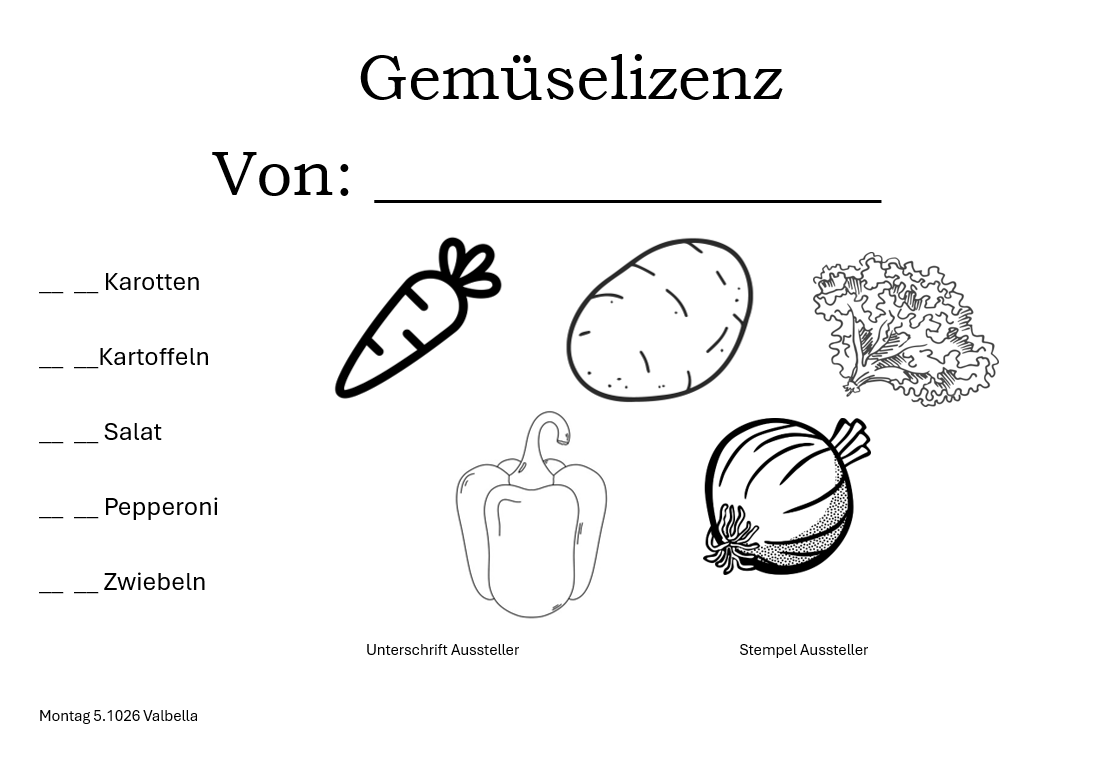
In the attached example document, we’ve used 5 different types of vegetables; I’ve printed 1 sheet of the rarest ones, 2 pages of the second-rarest, 4 pages of the third-rarest, 8 pages of the fifth-rarest, and 16 pages of the fifth rarest (i.e. the most common and cheapest resource), I printed 16 pages. I made sure that all the resource cards were the same size, so that the children would have to look at the picture to see what the resource was, rather than being able to deduce it from the size of the card. This number of cards was more than enough to keep 22 children (aged 8–12) engaged for two hours; twice during the game, we redistributed the cards from the market back to the collection area.
Licence cards
You’ll also need licence cards. You can either prepare these in advance and decide how much produce can be transported with each licence. The advantage of this is that you can give the licence levels cool names, such as ‘Hobby Gardener’, ‘Amateur Vegetable Grower’ or ‘Vegetable Pioneer’...
This type of licence system tends to encourage more smuggling, as a fixed amount is required to upgrade one’s licence.
However, there is also another type of licence that gives honest children a sense of achievement: individual licences. Here, the child can tell a leader what they’d like to transport in addition to their current licence, or the leader can look at the child’s money and suggest what they could get. It has proved effective to set the price for the upgrade at 2.5 times the value of what the child could earn per round;
For example, they might want to transport 4 extra bananas. At the market, one banana fetches 10,000 coins. This means they would earn (4 × 10,000 coins =) 40,000 coins more in future than before, so they would have to pay (2.5 × 40,000 coins =) 100,000 coins to obtain the licence upgrade.
It is advisable to write the child’s name on each licence so that they are not mixed up.
Value of the cards:
It has proved effective to increase the value of the cards by one unit of money for each level of rarity; for example:
most common resource = 10,000 per card
second most common resource = 20,000 per unit
third most common resource = 30,000 per unit...
Other equipment:
possibly barrier tape to cordon off safety zones/the playing area
Table for market stall
Ribbons to mark catchers
Pen to amend licences
Stopwatch/mobile phone/watch to time the time spent in prison
Calculator to work out licence fees
Container for collecting the cards handed in at the market
Rules:
Money or licences must not be exchanged amongst players; everyone keeps what they have earned themselves.
If a supervisor catches you, you must be honest and show all the cards you have on you.
If a supervisor catches you and you’re carrying more than is allowed, you must hand over all your money and cards (except licences) and go to prison for 2 minutes
You may carry a maximum of 15 cards at any one time; if you have more, the Market will confiscate them all. You won’t have to go to prison, but you won’t receive any money for them either. Otherwise, the Market doesn’t care whether what you’re carrying is permitted under your licence or not.
The player or group of players with the most money at the end wins.
Licences have no value at the end of the game.
The collection zone and the market are considered safe zones.
(If you’re fleeing from a catcher, you’re not allowed to throw away any cards that you’re not supposed to be carrying.)