Three slingshots, a catapult and a tree slingshot are described.
This article is a Forum magazine article.
Production and use
Slingshots are fun, but not entirely harmless! With the necessary care and practice, slingshots can be an exciting diversion in a competition.
Basic rule: Children who do not follow the rules explained above must hand in their slingshot!
Projectiles
Please ensure that only light objects are used for throwing. Lightweight projectiles can be made from light modeling clay or cardboard mesh. Pine cones or pieces of bark from nature are suitable. Important: even light objects can cause injuries if they hit a person with great force!
Stones are absolutely forbidden, even if the sling is usually called a slingshot! This also applies if the children have practiced and hit the target safely!
Throwing
Practice makes perfect
Handling the slingshot and hitting a target accurately requires a lot of practice.
Here's how it's done: all the children stand on one side. A target is set some distance away on the opposite side (e.g. tree, bush).
The projectile is now placed in the "bag" of the slingshot. The longer end is wrapped around the throwing hand. The shorter end is held loosely with the same hand. The slingshot is now turned over your head. As soon as the desired momentum is reached, let go of the shorter end and the projectile flies towards the target.
The only way to find out exactly when to let go so that the projectile flies towards the target is to practise.
So let the children practise individually so that they can see in which direction their projectile flies. Make sure that the other children keep a safe distance (also to the rear)!
Slingshot 1
Materials
Leather scraps, scissors, ballpoint pen
How to make
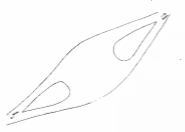
Draw the outline of the slingshot on the back of the leather with a ballpoint pen (enlarge the illustration below onto an A4 sheet). On one side there should be a ribbon about 60 cm long, on the other side the ribbon should be about 40 cm long.
Cut out the slingshot with scissors.
Slingshot 1
Slingshot 2
Materials
Shoe box, thin cotton yarn, thicker wool yarn, scissors, adhesive tape, needle, pieces of cardboard
How to make
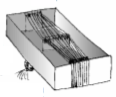
First you need to cut three pieces of cardboard. One piece must be about 10 cm wide, the other two pieces about 5 cm wide. Their height depends on the height of the cardboard box. The cardboard pieces are now cut on one side: Wide piece: 27 notches, narrow pieces 14 notches each. The cardboard pieces now look like small combs.
Now cut 27 threads, each 120 cm long, from the thin yarn. The threads are wrapped around the shoe box and knotted together under the cardboard so that they lie snugly around the cardboard. Now insert the middle "comb". A thread is pulled through each notch. To prevent the threads from slipping out of the comb, stick a strip of adhesive tape over the top of the notched side. Now insert the other two "combs" on both sides at a distance of about 9 cm. Pull a thread through the first notch and two threads through each of the others.
Now you can start weaving. The first 3 cm are woven with single yarn. The next 3 cm with double yarn and the remaining 3 cm to the middle with triple yarn. When the middle is reached, the middle comb can be removed. The slingshot is finished in reverse order. In this way, the slingshot is woven wider and thicker towards the middle.
After weaving, the longitudinal threads can be loosened. Now 9 threads must be knotted together close behind the woven part. All 27 threads can then be knotted together a little further back. Divide the threads into three parts again (9 pieces each) and weave a plait from the remaining threads. One of the "braids" can be longer than the other, see throwing.
Slingshot 2
Slingshot 3
Materials
Branch fork, wide rubber, knife
How to make
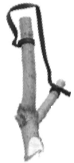
Find a smaller branch fork. Score both ends of the fork slightly all around with a knife. Attach the rubber band so that it is stretched tightly between the two ends of the branch fork.
Find a small object to throw (not a stone!). Hold the sling with one hand, fix the projectile in the middle of the rubber band with the other hand and pull it backwards. Aim at the target and release the projectile. Maybe it will be a hit...
The accuracy is greater with this slingshot. But here, too, rules must be laid down to prevent accidents!
Slingshot 3
Catapult
Materials
Roof battens 5 cm x 5 cm, bolts, screws, nails, saw, drill, hammer, rubber band
How to make
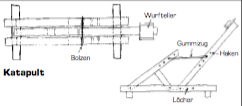
A catapult can be built from roof battens using the sketch shown.
The lever arm is movably mounted with a bolt. All other parts are fixed. The lever can be mounted individually by drilling various holes in the base beam. Now you have to try out which position is most suitable. Hooks are attached to the counter bearing and lever at various points, to which an elastic cord is attached to tension the lever. Here, too, it is important to try out which hook produces the best tension!
The throwing plate can be made from a wooden board, around which wooden strips are nailed to prevent the projectile from rolling away. A plastic container can also be screwed to the throwing arm.
Either anchor the catapult firmly to the ground with pegs or have some children hold it firmly in place while others cock and launch it.
Throwing material: soft foam balls or water bombs!
Catapult
Important:
The catapult is not very suitable for making with the children in the youth group, as a lot depends on the material and has to be tried out before it works! If you want to build a catapult with the children, you must first build a prototype so that precise instructions can be given regarding the length of the strips, the holes to be drilled, etc.!
Tree slingshot
Materials
Two sturdy trees, rubber rope, leather scraps
How to make
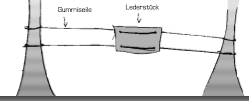
First cut a piece of leather to size and cut a hole in all 4 corners. The rubber cords can be pulled through here. cut 2 rubber ropes to the appropriate length (tree spacing and circumference). Stretch the rubber ropes between the trees. Thread on the piece of leather as shown in the illustration. Hold the projectile with the piece of leather and pull it back with the rubber ropes. Let go - and the projectile goes flying.
Please make sure that no path crosses the throwing line and that there is no danger to pedestrians!
Slingshot
Source reference

- Contents and picture: Forum Kind issue 3/06, page 23 + 24. Three slingshots, a catapult and a tree slingshot are described. © Copyright www.forum-kind.ch
- Author: Mirjam Leuenberger