Motivating a large group of children of different ages and backgrounds to sing is a challenge in itself!
Singing with children isn’t just about stringing one song after another together. It takes countless ideas to present the songs in a vivid and engaging way.
If I want to hold the children’s full attention for 15 minutes, I have to keep incorporating highlights and moments of excitement. When I realise that the children are no longer fully engaged, I have to interrupt my programme on the spot and come up with one of these ‘interludes’. I probably won’t come up with good ideas entirely on the spur of the moment; I need to have them up my sleeve. In my preparations, I also need to ensure that six-year-olds get just as much out of it as twelve-year-olds. Below are a few examples and ideas for organising a varied singing session on the theme of ‘fear’.
1. Song collection: ‘
’ I collect all the songs related to this theme. Not just songs in which fear features, but also songs that praise God as our refuge, our helper and our comforter.
Examples: ‘Au weni Angscht ha’; ‘wenn de Sturm tobt’; ‘wenn’s ganz dunkel isch’; ‘huu ghörsch du de Luft’ …
2. Visual aids
I’m collecting pictures, colour transparencies for the projector and objects relating to the current topic.
Examples: Me as a scaredy-cat (personal example); a short story; a colour transparency of a little chick hiding with its mother hen; pictures of a thunderstorm or an accident; as an ‘object’, I take my little daughter in my arms (a sign of security in the face of fear); spray-painting a banner: “Jesus is always there”...
3. Motivational elements
I look for ideas unrelated to the specific topic to motivate the children, spark their interest and encourage them to think.
Examples: rhythm instruments for the children; movements to go with the songs; two cards, one with a girl on it, the other with a boy (when I hold up the girl’s card, the girls sing; when I hold up the boy’s card, the boys sing, or both together); prayer; singing loudly and softly.
4. Structure of the songs
A lively song is a good way to start – it doesn’t necessarily have to be related to the theme just yet. After that, I choose songs that describe our fear and depict situations in which we feel afraid. The session concludes with songs that offer help and show a way out of fear.
5. Creative contributions
I incorporate the ideas gathered in points 2 and 3 into the structure of our singing session. They serve to explain the songs and aid understanding. Action songs require fewer additional contributions, whilst long, quiet songs require more. Sometimes a prayer or a short phrase that we all call out together is appropriate. For example, I count out “1-2-3: ‘Thank you, Jesus, you never leave me alone!’” It’s particularly important to bear in mind with this element that the children will only join in if it’s clear when they’re supposed to say what.
Good preparation
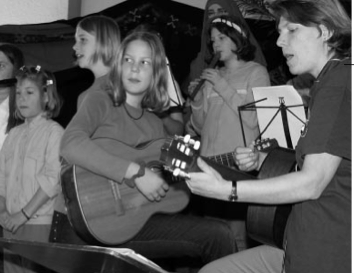
To ensure I can motivate and guide the children effectively, I often ask teenagers if they’d be willing to support me on the piano or guitar. It’s important that I set aside some time a few days in advance to practise the accompaniment with the teenagers. Why not ask one of the older children to help with the slides?
In my view, the singing session shouldn’t be unnaturally well-behaved, quiet and orderly. Why not try something a bit mad for a change? Whistling a song, stamping your feet, shouting or rapping the lyrics? The children should sing and worship God just as they are – and they’re usually not well-behaved, quiet or orderly. Children don’t have to be well-behaved adults just to please God!
Source:
Content and image:
forum kind 3/02, page 12, Regula Salathé, musical collaboration with Adonia
Copyright www.forum-kind.ch
Kids’ Club: Introducing ‘Singzeit’