The playful experiments with the rain pipe are about listening to each other and working together in a group.
This article is a Forum magazine article and is attached as a pdf file.
Crafting - and playing with sound and rhythm
Games with sound and rhythm, accompanying songs, different fillings when making a rain pipe - using the rain pipe can be exciting.
The playful experiments with the rain pipe are about listening to each other and working together in a group.
Production of a rainwater pipe:
Material for making a pipe:
- Cardboard shipping tube, diameter approx. seven to eight centimeters, with two plastic caps.
- Nails approx. five centimeters long
- Filling material: peas, granules, small nails
- Wood glue, napkins and glossy coating for decorating.
Tools:
- Pencil and hammer
Building instructions:
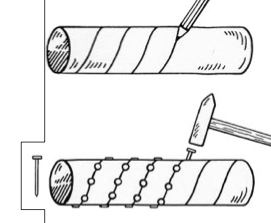
Draw a spiral line on the shipping tube. The nails are hammered in at a distance of approx. one and a half centimeters. One cap is placed on top and glued and the rain pipe is filled with a mixture of granules or small pebbles, peas or small nails. The second cap is then glued on. The rain pipe can be painted with acrylic paint and decorated with a napkin technique.
It all depends on the filling:
Depending on the filling, the rain pipe will have a different sound. Small pebbles, peas, small nails, granules, etc. are suitable. For later use of the rain pipe in the group, it is attractive if not all pipes are filled in the same way.
Suggestions for using the rain pipe
Games with sound & rhythm
The rain pipe can be used for many playful experiments with sound and rhythm. It is also about listening to each other and working together in a group:
- Making it trickle - fast and slow - how do the different fillings sound?
- Conductor game: The children sit in groups (according to the contents of their rain pipe). One child shows which groups are allowed to play in turn. Variation: Another child as "rain detective" closes their eyes and guesses which filling was just heard.
- Tapping rhythms: The children sit or kneel on the floor and hold the pipe vertically in front of them. The pipe is moved up and down and "tapped on the floor" ("step-step-step...") or shaken ("loufe-loufe-loufe...").
- Tapping with wooden sticks or mallets: Tapping rhythms on the rain pipe. The rain pipe serves as a sound box, the grains cannot be heard.
- Lead - follow: One child shakes their pipe and leads the way, the other child follows with their eyes closed. Played as a group game (several pairs at the same time), this requires a high level of concentration!
Accompanying songs
If we use the rain pipe to accompany a song, it is advisable to agree on the rules of the game:
- Which part of the song will be accompanied (e.g. as an intro and finale, or only during the chorus)?
- Who accompanies (all children, a group, a sound group according to the filling of the pipe...)?
- Variety in the type of play (trickling, tapping, shaking...).
Of course, songs that are in some way related to water are particularly suitable:
- Lueg de Rägeboge aa 1 / 2
- De Seestern 1 / 2
- When the storm rages 1
- Du Gott bisch d Quälle 2
- Lord, your grace, it falls on my life like the rain...3
1 "Frisch und Fröhlich" Adonia/BESJ
2 "Lord, I praise you" BLB/ERF
3 "You are Lord - Kids 2", projection J
Source reference

- Content and picture: Forum Kind issue 2/04, p. 23. Play with sound and rhythm - handicrafts. © Copyright www.forum-kind.ch
- Author: Beatrix Henney