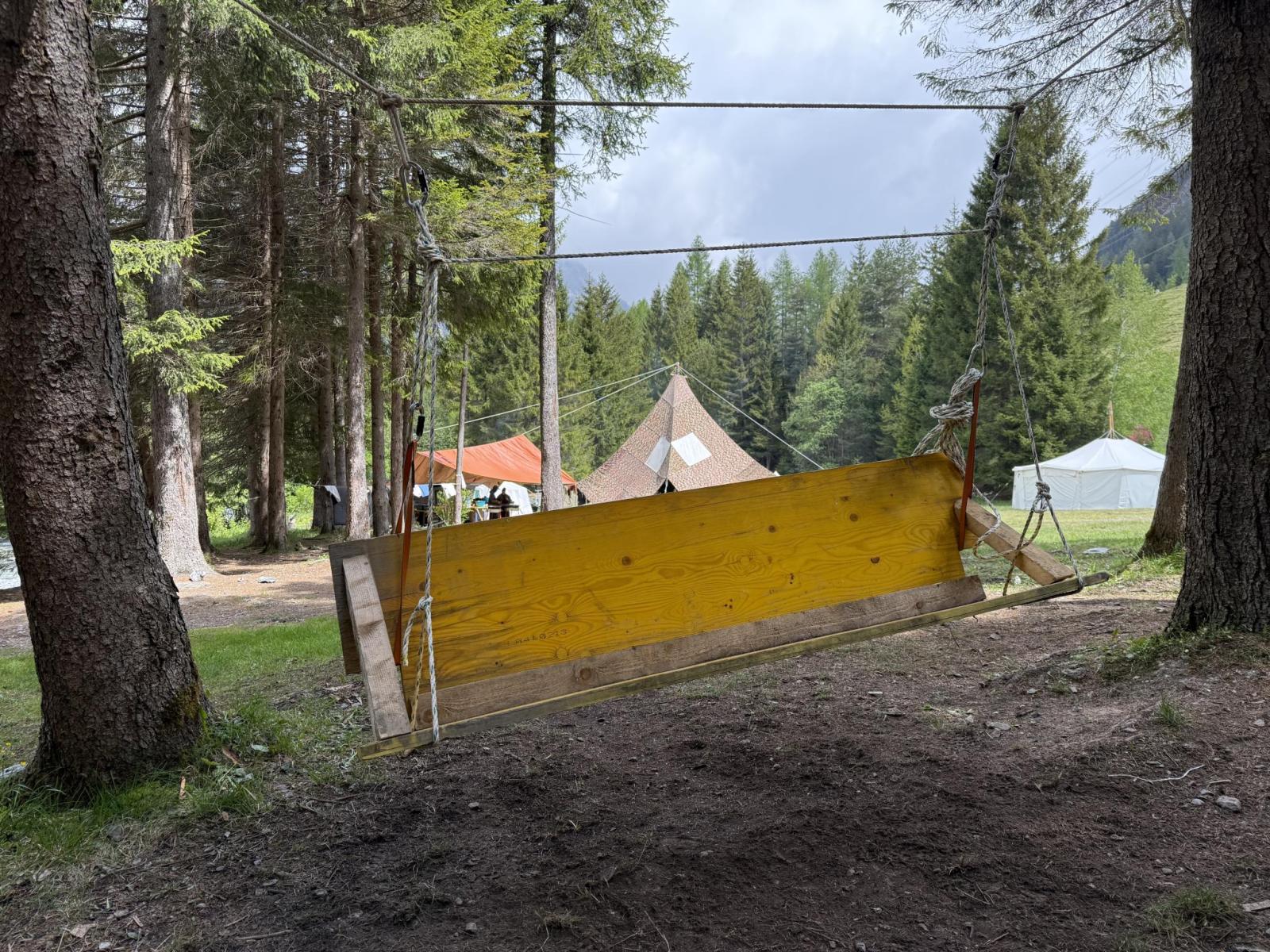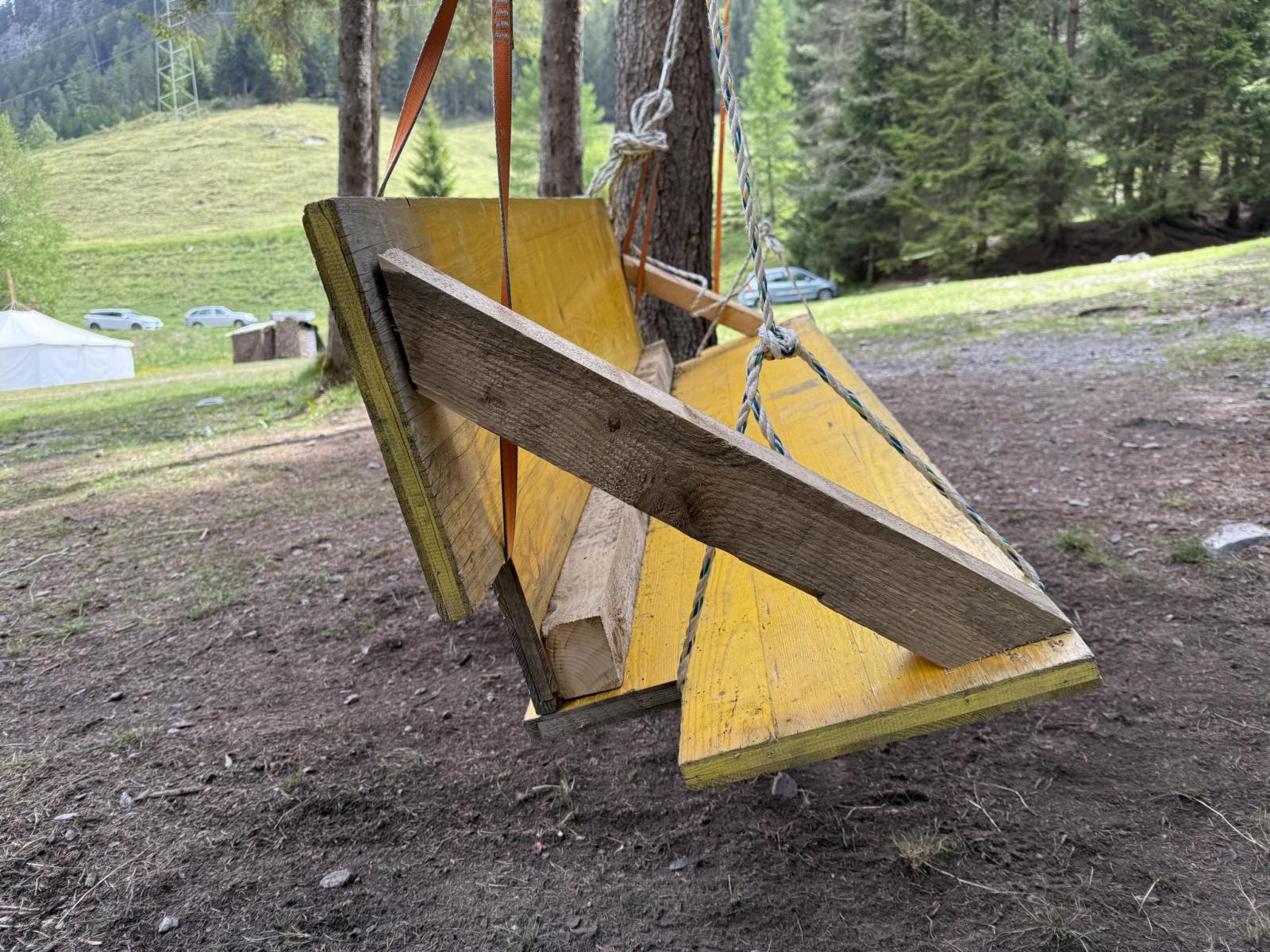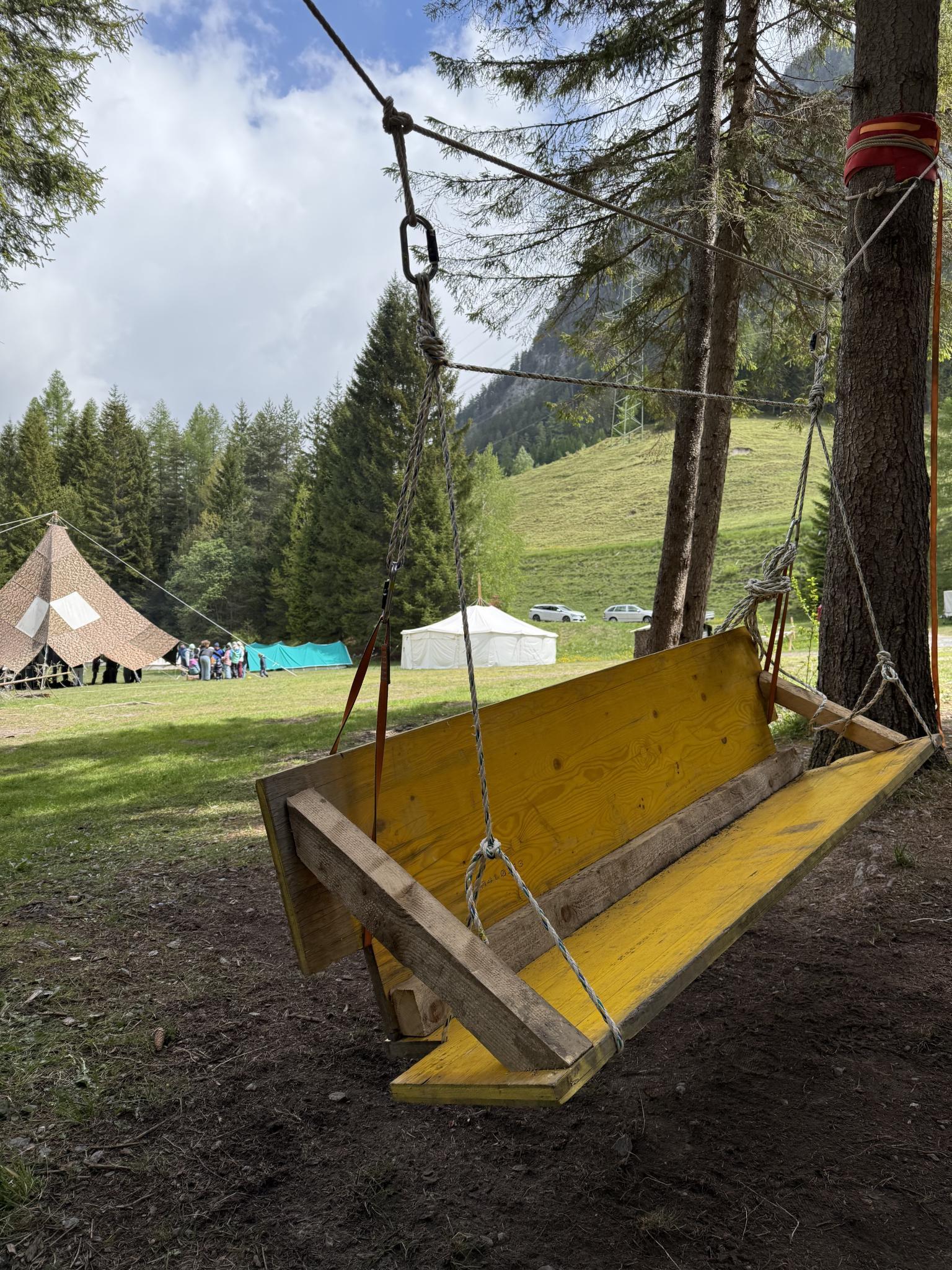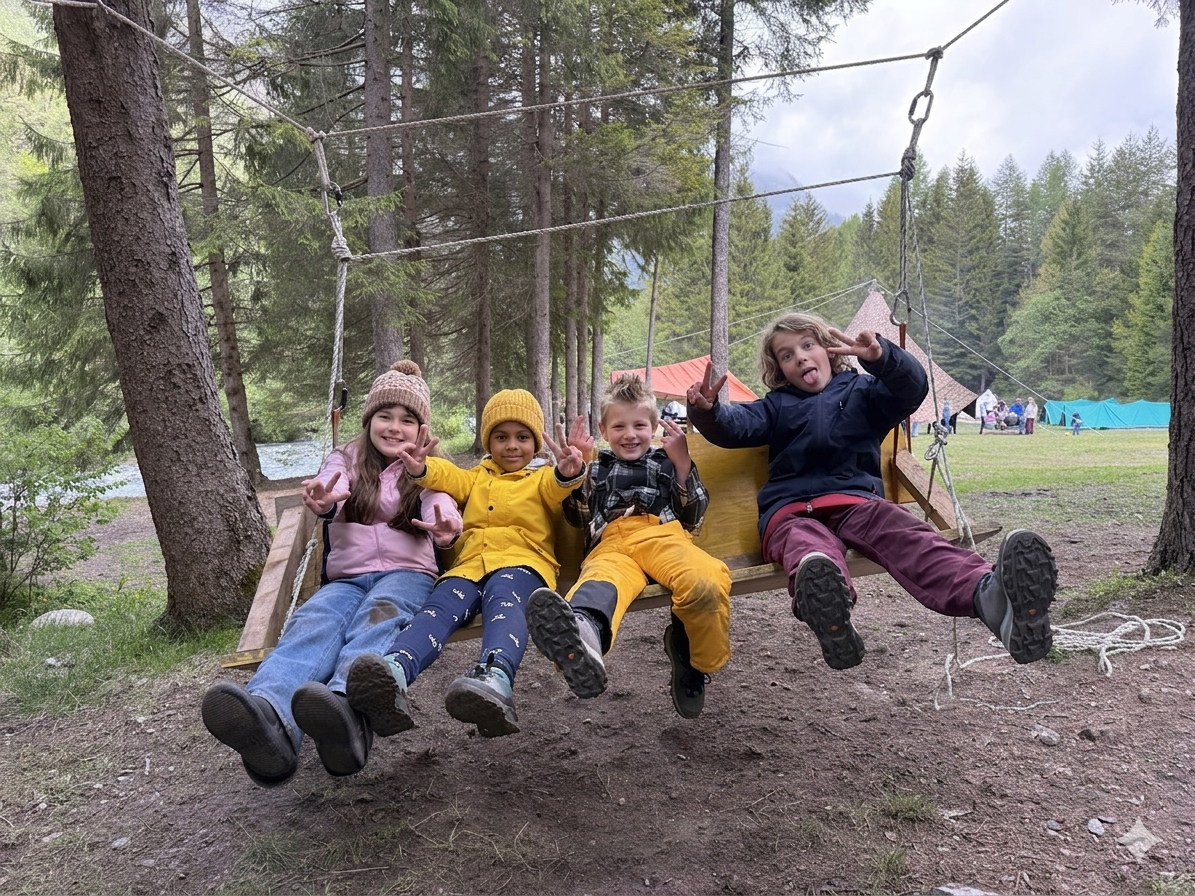
This homemade Hollywood swing is an ideal gadget for camp building. It can accommodate several people and can be easily constructed in the woods between two trees using readily available materials such as form boards and square lumber. Compared to structures made of tarps, this version offers a significantly longer lifespan even with heavy use.
Pros
- High comfort factor: Accommodates up to four children or teenagers at a time.
- Affordable materials: Formwork panels (Doka panels) and square lumber are often available as leftover materials on construction sites or in warehouses.
- Easy to transport: The swing consists of just a few parts and can be transported flat on a trailer.
- High mechanical durability: With conventional swings made of tarps, the tarps regularly tear due to children’s rough play. The solid wooden construction made of formwork panels is extremely robust, dimensionally stable, and easily withstands this stress.
Cons / Risks
- High static load: Due to the swing’s own weight and the weight of multiple people, enormous forces act on the suspension and the trees.
- Shear forces on screws: The connection between the seat and the backrest must be extremely sturdy, as high lever forces act here.
- Risk of splinters: Worn-out formwork panels can splinter. Edges must be sanded down beforehand.
Material
- 2 form panels (Doka panels), ideally 200 cm (or cut to size as needed)
- Sturdy lumber (min. 60 x 80 mm) for the side angle brackets and joists
- Sturdy wood screws / particleboard screws
- Static rope or old climbing rope (high breaking load) for the support rope (or beam)
- Materials for hanging (webbing slings, carabiners, tree protection)
Tools
- Cordless screwdriver with matching bits
- (Handheld) circular saw
Instructions
- Seat & backrest: Cut two formwork panels to the desired length (approx. 150–200 cm), if necessary.
- Connecting piece: A long square timber the same length as the formwork panels is needed to connect the seat and the backrest.
- Screw the seat and backrest together using the long square timber.
- Side support braces: Make two diagonal braces from the square timbers (large enough to provide the necessary stability).
- Attach the diagonal braces to the sides.
- Secure the suspension rope between two trees (do not tighten it too much). Two bowline knots are suitable for hanging the swing.
- Attach the swing to the suspension rope.
Safety Instructions
- Ground clearance: Adjust the swing so that, when loaded, it hangs approximately 40–50 cm above the ground.
- Screw inspection: After the first test runs and before each day of use, check the screw connections for tightness and the wood for cracks.
- Cushioning: The ground beneath the swing should be free of stones and hard roots (bark mulch or forest floor are ideal).
Image credits
All images provided by ML3000. Faces in the cover image were replaced using Google Gemini.
Pictures