Beneath the clouds, freedom must surely be boundless...
This article is from a Forum magazine issue.
The first man-made flying objects ...
... following the development of the bow and arrow were likely kite-like devices used for both art and warfare. Legend has it that as early as 200 B.C., a Chinese general used a kite to measure the distance between his army and the enemy city, and then emerged right in the middle of the city through a tunnel of exactly the right length.
So it’s no surprise that for centuries, the Chinese were leaders in kite-making. We owe many of the kites’ forms and developments to them.
Simple Hexagonal Kite / Stunt Kite
Simple Hexagonal Kite
This fairly simple type of kite can be made with very few materials.
Materials
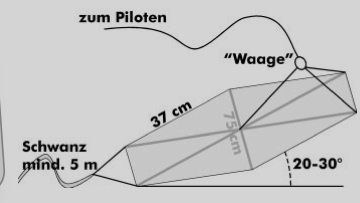
- a piece of plastic (e.g., a trash bag), heavy-duty paper, or canvas, hexagonal, with a diameter of 75 cm
- Strips of plastic or fabric, approx. 5 m x 10 cm
- 3 small wooden sticks, each 75 cm long
- At least 50 m of kite string
- Scissors, glue (for paper kites) or a needle and thread (for fabric/plastic kites)
- Paint for decorating
- Small metal ring, 1–2 cm in diameter
- Reel
Instructions
Cut the fabric to the hexagonal shape and hem the edges to prevent fraying.
Sew a loop into each corner, through which the three rods are threaded in a crisscross pattern.
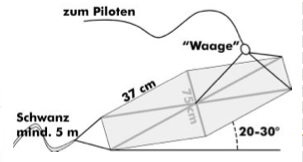
A piece of kite string (approx. 1.6 m) is attached to the front (two adjacent corners). The small ring is attached exactly in the center. A second piece of string (approx. 80 cm) is also tied to the small ring. The other end is attached to the center of the kite so that the kite—held by the ring—hovers in the air at an angle of about 20–30°.
Make the tail—which gives the kite flight stability—from a strip of fabric or plastic at least 5 m long. For reinforcement, you can sew a string into the center of the tail. Attach the tail to the center of a string approximately 1.5 m long. Tie the ends of the string to the two corners opposite the front.
Finally, tie the long kite string to the ring and wind it onto the reel.
Paint the fabric surface or decorate it with patches according to your own ideas.
Stunt Kites
Steerable kites are somewhat more time-consuming and complicated to make. Adjusting the “balance” in particular requires a fair amount of patience and precision. It is recommended that you consult relevant technical literature for this purpose.
Aerobatics
To fly amazing loops, horizontal eights, or a rectangle, you’ll need a stunt kite (suspended by two lines), a lot of finesse, and patience as you experiment.
An exciting competition can be held as a “kite battle.” The goal is to cut your opponent’s line with your own through friction. To do this, bring the line of your kite from below to touch your opponent’s. As soon as the two lines touch, let out as much line as possible. The winner is whoever still has their kite in the air at the end.
And if your kite is big enough, you can let it carry you to measure the distance between your starting point and the enemy’s city. Now all you have to do is dig the tunnel, and the prize is yours...
References

- Content and image: Forum Kind, Issue 3/04, page 22. Kite-making, indoors, outdoors, flying kites. © Copyright www.forum-kind.ch
- Author:Lori Keller, BESJ Secretary