Supplement to Camp Sports/Trekking
What is a games festival?
A Games Festival is a programme of games and sports for the J+S Kids age group, with the focus on sporting variety. At various stations, the children can complete a variety of physical activities and discover new games. They visit these stations in small groups. The focus is not on competition, but on the joy of varied physical activity. As with any camp sports programme, the same applies to the games festival: the children should learn something , achieve something physically and be able to laugh their hearts out in the process .
The basic structure of the games festival
Three-part structure
- During the warm-up , the children are taken out of their everyday camp routine and got in the mood for the sports day. At the same time, the groups should be formed and the programme for the main part explained. There may also be unsupervised stations in the main part, which you will need to explain to the children at this stage.
- The main part is where the focus lies in terms of both content and time. This is where the sporting variety of the games festival really comes into its own. The main part is divided into various stations.
- The wrap-up should be designed to be calming and help the children wind down after letting off steam. Once the children have taken part in the main part in small groups, the whole group comes back together for the wrap-up and brings the games festival to a close together.
A variety of movement activities:
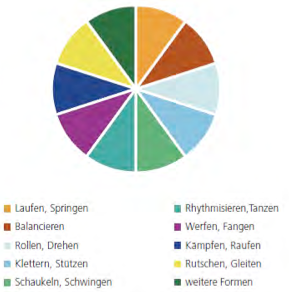
At the play festival, the children should be able to work on their motor skills and abilities and experience the variety of basic forms of movement. When planning your play festival, therefore, ensure that the main part covers at least four different basic forms of movement . The illustration below provides an overview of the basic forms of movement. They are described in more detail in the information sheet ‘Diverse play and sport blocks’.
The basic forms of movement
Group formation
As the activities in the main part of the session are carried out in small groups at various stations, each child can be supported at their own level. When forming groups, bear the following points in mind:
- Groups should consist of three to five children .
- It is helpful if the children in a group are at a similar stage of development . This allows them to try out the basic movement patterns together at the same level
. - Consider whether it is necessary for the stations that the
groups consist of an even number of children (e.g. for stations where the children play a game against each other).
Number of stations and duration
The number of stations depends on the number of groups, the duration of each station and the total duration of the games festival. To ensure that the children can truly experience the spirit of the games festival and that the various basic movement patterns are covered, at least four different stations must be offered in the main part of the programme.
The duration of each station depends on its content and the number of stations. However, a station duration of around ten minutes has proven to work well. Don’t forget to allow time for moving between stations!
The total duration of the games festival should not exceed one and a half hours, otherwise it will become monotonous for the children and they will start to get bored. As the structure of the games festival is rather complex, it should not last for less than an hour.
Variations and design elements
- By varying the types of stations and using design elements, you can ensure that your games day is varied and imaginative.
Station formats
There are various types of activity stations: - Free exploration: Children can freely explore a basic movement pattern
. E.g.: Juggling/the ‘Balloon Artist’ game from ‘Top Bewegungsspiele’, p. 101. - Competing: The children are given the opportunity to compete against other children and, in doing so, discover their strengths and weaknesses. E.g.: Target throwing / the ‘Capture the Ball’ game from ‘Top Movement Games’, p. 77.
- Achieving a goal together: The children are given a sporting task that they can only complete together as a group. E.g.: building a human pyramid, the ‘Robot’ game from ‘Top Movement Games’, p. 28.
Make sure that all three types of station are included in your games festival!
In addition, a distinction can be made between supervised and unsupervised stations . Unsupervised stations are completed by the children independently, whilst supervised stations are carried out under the guidance of a leader. For unsupervised stations, care must be taken to ensure that the stations are simple in design and can be understood without explanation. These stations should be briefly explained during the warm-up. Games that involve competition carry the potential for conflict and therefore require supervision. Activities with an increased risk of injury should also be carried out at supervised stations.
Connecting elements
A connecting element ensures that the individual stations in the main part of the session do not exist in isolation from one another. Ideally, the connecting element should be linked directly to the thematic framework. Here are a few examples:
• Collecting jigsaw pieces: The groups earn a jigsaw piece at each station, for example part of a treasure map. The treasure map is then put together at the end of the session.
• Station pass: Each child has a station pass and receives a stamp or a sticker as a reward at each station. Only a fully completed station pass is valid as a ticket to Magic Land.
• Collecting items: During the games festival, the groups collect items – for example, the ingredients for a magic potion. At each station, they earn an ingredient through their efforts. After the games festival, the magic potion is brewed together.
• Designing the route: The route to the next station is specially designed; for example, the children might have to feel their way along a rope whilst blindfolded, reach the next station only by hopping in a specific pattern, or follow tracks on the ground. Ideally, the reason for the specific mode of movement should also be derived from the theme.
These are just a few ideas that you can expand on as you wish. This is where your imagination comes into play!
Games Festival or Games Tournament?
The games festival is an age-appropriate alternative to a games tournament for the J+S Kids age group. Unlike a games tournament, the focus of the games festival is not on competition but on the joy of varied physical activity and playfully trying out new things. The individual stations can certainly be designed in such a way that children can compete against each other in small groups. However, as the desire to compete is less pronounced among children of J+S Kids age than among teenagers, this aspect should not be the main focus. At J+S Kids camps, games festivals should be held instead of sports tournaments.
Further resources
Here you will find further information and ideas for organising games and sports activities with children of J+S-Kids age:
- Brochures ‘J+S-Kids – Theoretical Principles’ and ‘J+S-Kids – Practical Examples’
- Ring binders ‘Top Movement Games’ and ‘Top Games for PE Lessons’
- CDs ‘Music and Movement: Movement Imitations for Kids’ and ‘Music and Movement: Movement Games for Kids’
- Fact sheets “J+S-Kids: A Variety of Play and Sports Sessions” and “J+S-Kids: Hiking with Children”
References:
Contents:
Federal Office of Sport (BASPO), Youth+Sport, J+S-Kids resource ‘Camp’, information sheet ‘J+S-Kids: The Games Festival’ – March 2010 edition
Cover image:
Clipart courtesy of the publisher buch+musik ejw-service gmbh, Stuttgart –www.ejw-buch.de