In diesem Geländespiel für Teens und Jugendliche geht es darum, verschlüsselte Botschaften durch die gegnerischen Reihen hindurch zur eigenen Basis zu bringen und diese zu entschlüsseln.
Material
- 1 plastic bottle or similar per player
- Permanent foil pen in code colors (1 set per group)
- Barrier tape
- 1 envelope per group, each containing 2 codes and a table
- paper and pens per group for decoding
- Mark players (ribbons)
- Colors of the codes correspond to group colors
- Alcohol to remove the messages on the bottles
- Marking for bases
Alternative:
Paper slips instead of plastic bottles (cheaper!). For groups of 50 people or more, we recommend playing the game with paper. The messages should already be printed out and cut to size so that they do not have to be written down on the spot. The decoded messages can be brought back to the issuing station by a member of staff and used again.
Preparation
- find a suitable play area (a flat wooded area with little undergrowth is suitable)
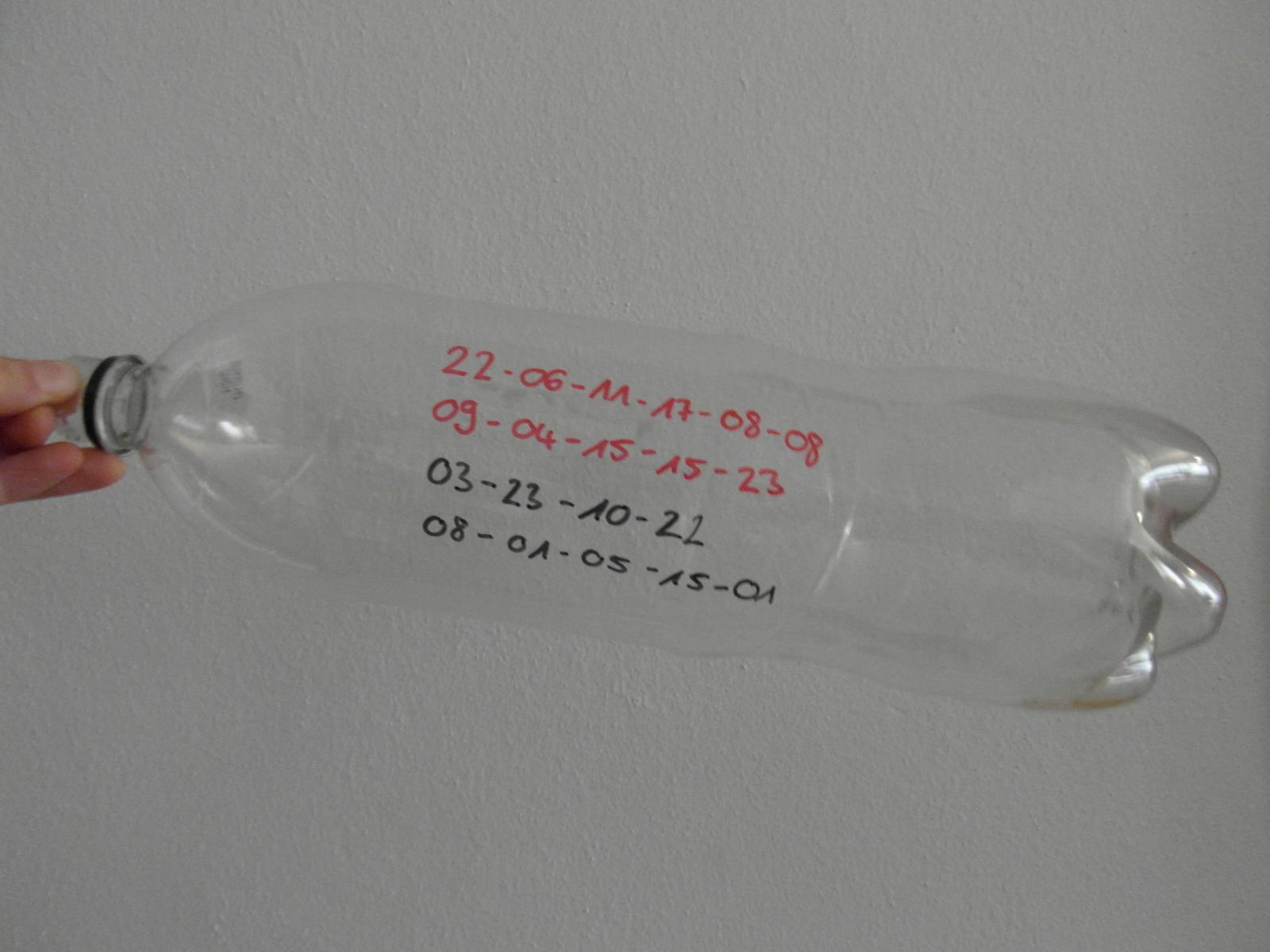
- Think of messages to decode. The message consists of a meaningful sentence with 4 words and a maximum of 7 letters per word. The message is encrypted by converting the letters into two-digit numbers. (see table). A message always consists of sequences of numbers written in two different colors. Each color is assigned a code. The groups have to find out which color belongs to which code in order to decode the message correctly.
- Each group has a common code with each of the two Enemies.
- Figure out the code: The code +11 means, for example, that the letter A, which is in the table A=01, is shifted by 11 letters. à A=12! The word "good" with this code is therefore 18-32-31.
- The messages can be repeated.
- Write a message on each bottle so that the players can start immediately.
- Give the coded messages belonging to the groups to the responsible employees at the output bases.
- Mark the playing field and bases
Codes (example)
Game plan
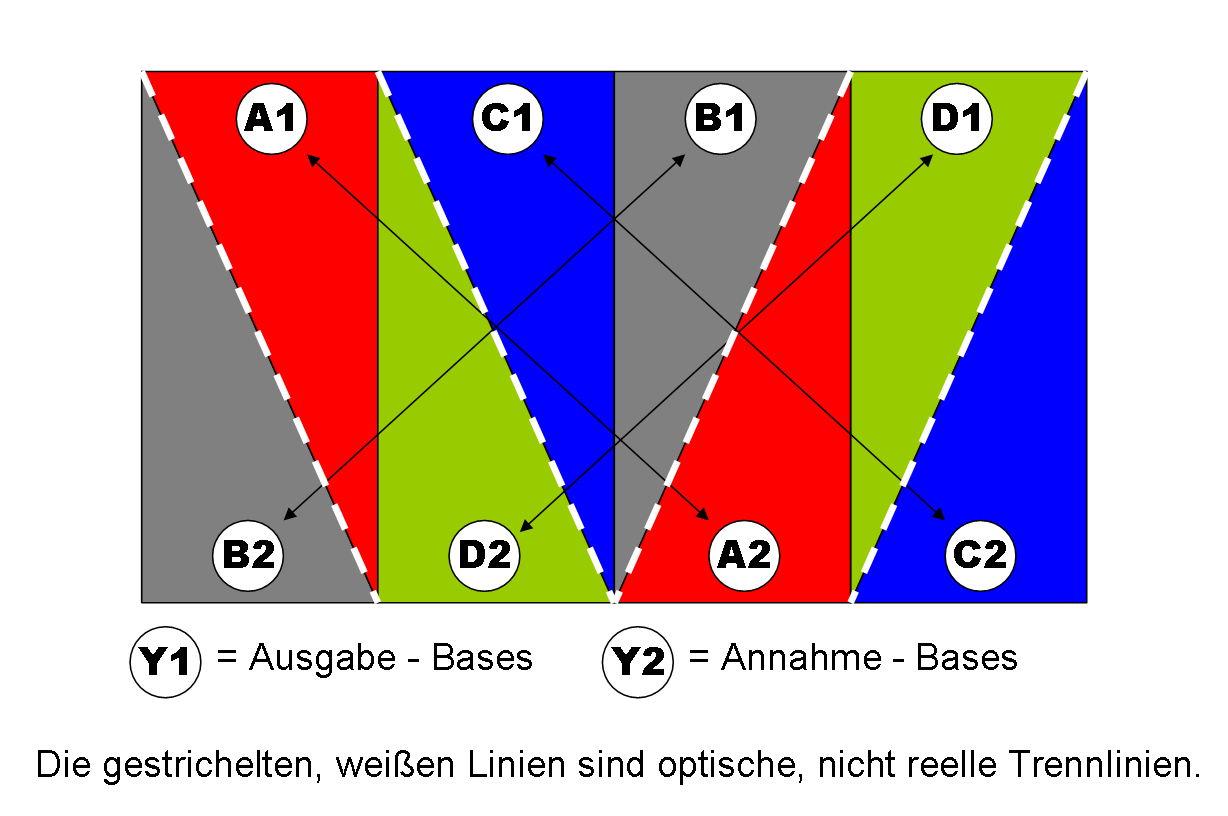
Implementation
- Groups are formed depending on the number of participants (even number of groups!)
- The playing field is divided into several parts depending on the number of groups. In this example, there are 4 groups, i.e. 4 parts. Each group owns two of the small fields, but there is always an enemy field between them. Each group shares its two fields with another group. They are therefore "neighbors". The other two groups are therefore "Enemies".
- In general, each group plays for itself and tries to score as many points as possible. If desired, they can form alliances with their neighbors to exchange information. They can also decide not to and play in isolation.
- Before the game begins, the groups each go to their field with the output base.
- There they receive an envelope containing a table and 2 codes from the responsible employee. Each player also receives a plastic bottle with a different coded message from the group written on it. (Please note: the messages must match the codes given to the groups!)
- The groups now receive a colored ribbon for each player to identify them. What the players don't know at first is that their color is also the corresponding color of a code. As the game progresses, this will quickly become apparent and help the players to defeat the desired opponents.
- At the start of the game, the players now try to bring their bottle with the coded message diagonally through the enemy field to their acceptance base.
- If a player succeeds, they can try to decode the message on their bottle at the base in question using the code and the table.
- A message consists of 4 sequences of numbers written in 2 different colors. The first task is to find out which code can be used to decipher which color.
- The groups are provided with paper and pens with which they can write down the decoded messages and the information that seems important to them.
- The group receives 10 points for each correctly decoded message.
- Once a message has been decoded, it is deleted from the bottle and a player tries to take it through the enemy line to the output base. There, a new message to be decoded is written on the bottle.
- In general, the following applies: An encrypted message is written on the bottle at the output base. At the receiving base, the message is decrypted and then wiped off the bottle.
- You can be knocked off in the opponent's field. A player may only catch other players if they are not carrying anything themselves! If you touch an opponent, they must hand over their bottle to the attacker. The attacker can now take his booty to his own acceptance base and check whether one of the group codes could be used to decode the opponent's message.
- If you have captured a bottle, you can also transfer the message to a piece of paper to be decoded later. The message on the bottle is deleted and can now be used for your own transportation.
- Once the message has been decoded, it is deleted! A bottle only ever carries one code.
- How does the group get hold of the unknown code? It may not be stolen, but is obtained by negotiating with the "neighbors". The bases of the other groups are off limits. Negotiations take place outside the base boundary.
Proof of source
- Cover picture: MariES
- Listed files: MariES
- Anmelden oder Registrieren, um Kommentare verfassen zu können